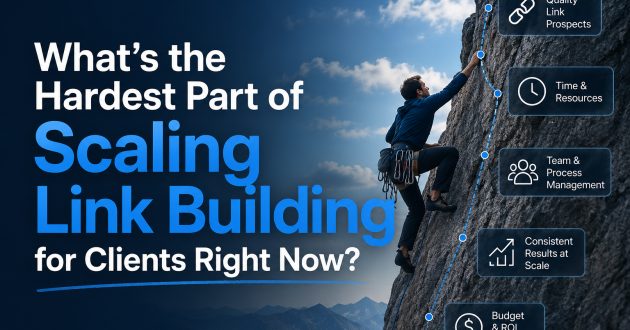
As link building changes, agencies and in-house teams are both dealing with a major challenge: how to find a balance between growth, quality, relevance, or long-term SEO results. This issue impacts the entire industry, but we’ve also faced it at Reach For Links while working on projects and meeting client expectations.
To better understand the issue and identify a preferable solution for both agencies and clients, we asked industry professionals the following question:
The Question: “What’s the hardest part of scaling link building for clients right now?”

SEO Expert 01: Michelle Symonds, Founder & Director, Ditto Digital
Website: dittodigital.co.uk
In a way, this question needs to be reframed because link-building should not be approached from the perspective of scale but of quality. That has always been the case, but because it was once possible to achieve scale and quality, many SEO strategies still aim for both. The SEO industry, as a whole, needs to adapt to what is really required to achieve visibility in Google search and in AI systems.
Google has long said that backlinks are about quality over quantity, so this is nothing new, but because there is a market selling links at scale, people think they should be buying them at scale. Yet that marketplace is crowded with poor-quality links.
So, in answer to the question about the hardest part of scaling link-building, it is actually weaning the industry off the never-ending treadmill of more and more backlinks and instead focusing on a different approach. That approach is digital PR aimed at building a company’s reputation and credibility via media relations and content. Backlinks are a valuable by-product of digital PR activity, but equally so are the unlinked brand mentions that Google and AI systems use to determine the credibility of a business.
Of course, this requires managing the expectations of clients when it comes to how many backlinks can be gained in a given period. And also re-educating both clients and SEO professionals on the value of a single, genuinely high-quality link over multiple poor-quality links.
Key Takeaway
The main point is that the biggest challenge is not just scaling link building, but changing the mindset around it. Instead of chasing a large number of backlinks, businesses should focus on getting fewer, higher-quality links that build real trust, authority, and brand reputation. Digital PR is a better long-term approach because it helps earn strong backlinks and brand mentions naturally.
How We Are Solving the Issues and Applying the Solutions Mentioned by the Expert
We are solving this issue by focusing more on quality than quantity in our link-building work. Instead of trying to get as many links as possible, we aim for strong, relevant links from trusted websites. We are also using digital PR strategies to help build our clients’ reputations through useful content, media coverage, and brand mentions. We utilize Muck Rack, Prowly, Connectively (formerly HARO), and Qwoted to establish relationships with media platforms. At the same time, we make sure to explain to clients that one high-quality link can be much more valuable than many low-quality ones. This helps set better expectations and creates stronger long-term results.

SEO Expert 02: Lewis Adcock, Freelance SEO Consultant
Website: www.lewisadcock.co.uk
The tactics that scale have gotten riskier, and the tactics that focus on quality have increasingly become harder to scale. Google’s crackdown on link building has coincided with the rise of link marketplaces that treat placements like a commodity, surfacing volume over value. The result is an industry where it’s never been easier to buy 50 links and never been harder to earn ones that are considered the gold standard.
Genuine editorial placements work, but they naturally resist being part of a scalable system, and clients rightly expect demonstrable ROI from their investment. Bridging that gap between what scales and what performs is the challenge most SEOs are wrestling with right now.
Key Takeaway
Lewis Adcock’s major perspective is that the easiest ways to form links are also the most dangerous. At the same time, it’s far more difficult to scale the methods that work best, like real editorial placements. It’s easy to buy many links, but it’s hard to get the high-quality links that really help your rankings and develop trust. Achieving the right balance between scalable methods and effective ones poses the greatest challenge at present.
How We Are Solving the Issues and Applying the Solutions Mentioned by the Expert
We are dealing with this challenge by focusing on quality-first link building instead of chasing large numbers of easy links. Rather than relying on risky tactics or bulk link marketplaces, we spend more time creating strong content and reaching out to relevant, trusted websites. In order to promote the content, we develop SEO Power Pages and use excellent techniques like Skyscraper, Broken Link Building, Resource Page, Wet Clay, and the Apple Sauce Technique.
We also work closely with clients to help them understand that real SEO value often comes from a few strong links, not just a high number of backlinks. This helps us build safer, more effective campaigns that support long-term growth.
SEO Expert 03: Chris Coussons, Founder, Visionary Marketing
Website: visionary-marketing.co.uk
The scaling problem nobody talks about is relationship decay. Link building at scale requires outreach relationships with editors, bloggers, publishers. But those relationships go stale fast. Someone who replied to your pitch six months ago has probably changed roles, changed their editorial focus, or just stopped caring about contributor pieces. We were seeing roughly a 35% response rate drop every quarter on previously warm contacts. So now we treat our outreach database like a CRM – regular touchpoints, value-adds, not just “hey, can we place another article?
Key Takeaway
Chris Coussons points out a problem that many people do not talk about enough: relationships do not stay strong forever. In link building, agencies often depend on editors, bloggers, and publishers they have contacted before. But over time, those people may change jobs, change their content focus, or stop replying. This means that even warm contacts can become inactive, making it harder to scale outreach successfully.
How We Are Solving the Issues and Applying the Solutions Mentioned by the Expert
We are solving this by managing our outreach contacts more carefully. Instead of only reaching out when we need a link or placement, we stay in touch regularly and try to build real relationships. We utilize Buzzstream to track relationships and add updated data and hooks to every website in our database.
We share useful ideas, send relevant content, and keep communication active over time. This helps us maintain trust with publishers and improves our chances of getting quality placements in the future.

SEO Expert 04: Tom Jauncey, Head Nerd, Nautilus Marketing
Website: www.nautilusmarketing.co.uk
I would say the hardest part about scaling linkbuilding is keeping quality high. A lot of agencies will build poor links in mass volume; I would rather build fewer links with higher metrics, which will see better results in the long term. A lot of people prefer quantity over quality; I always prefer quality, especially with how quickly the link-building space is changing.
Key Takeaway
Tom Jauncey believes the hardest part of scaling link building is maintaining quality. Many agencies try to build links in large numbers, but this often leads to poor-quality placements that do not offer real long-term value. He prefers building fewer links with better metrics because they are more likely to support strong and lasting SEO results. His view is clear: quality matters more than quantity, especially as link-building keeps changing.
How We Are Solving the Issues and Applying the Solutions Mentioned by the Expert
We are solving this by putting quality first in every campaign. Instead of chasing a high number of backlinks, we focus on getting links from relevant and trusted websites. We carefully review each opportunity before moving forward, so we do not waste time on weak placements. We selected blogs that do not simply aim to sell links but have a real presence in local businesses. We do not accept “write for us” type blogs and “mixed niche” websites. These are RED FLAGS. The traffic countries are also useful in identifying spammy websites (i.e., we don’t use that site if it has less than 80% US/UK/Canada/Australia traffic).
This helps us build safer, stronger, and more valuable links that support long-term growth for our clients.

SEO Expert 05: AGR Technology Team, AGR Technology
Website: https://agrtech.com.au
One of the challenges is filtering out fake or low quality websites which may look good on the surface however after analyzing are completely worthless and often have no traffic or rank for heavily inflated keywords to make it seem like they have lots of traffic.
Key Takeaway
The AGR Technology team says one major challenge in scaling link building is spotting fake or low-quality websites. Some sites may look good at first, but after proper analysis, they offer little or no real value.
How We Are Solving the Issues and Applying the Solutions Mentioned by the Expert
We look beyond surface-level metrics and review real traffic, keyword quality, and overall site value. We take the last 3 months of Ahrefs’ previous monthly traffic data and extract ranking keywords. We put them into a Google Sheet and use the ChatGPT API to identify if the keyword is real or spam.
This helps us avoid poor placements and focus on websites that can bring real SEO benefits.

SEO Expert 06: Rakibul Islam, Link Acquisition Expert
Website: https://rakib.digital/
The greatest challenge in growing link building right now is not only acquisition but also retaining brand integrity while doing it at scale.
Scruffy outreach is small-scale. But as you scale across many clients, each email you send is a direct representation of the brand. That’s what most companies fail at discreetly.
Many teams focus on volume and ignore the infrastructure. They email domains without the proper warm-up, skip dedicated SMTP settings, and use unverified or scraped prospect lists. It sounds appealing on paper. In reality, it slowly hurts the sender’s reputation, lowers deliverability, and most importantly, makes publishers lose faith in the brand.
The core issue is that link building is becoming a customer-facing activity, not just an SEO function. You’re not simply “building links”; you’re representing a company in someone else’s inbox. One poorly targeted or low-quality email doesn’t simply go ignored. It builds a terrible perception of your brand that compounds over time.
Outreach teams should use brand knowledge, not templates, to create personalized and authentic communication that resonates with potential clients.
And in today’s atmosphere for outreach, you can’t restore trust and reputation if they’re damaged, no matter how much volume you do.
Key Takeaway
Rakibul Islam highlights that the biggest challenge in scaling link building is not just acquiring links, but maintaining brand trust and integrity at scale. As outreach volume increases, every email reflects the brand, and poor infrastructure—such as unverified prospect data, weak email setups, and generic outreach—can damage sender reputation, reduce deliverability, and harm long-term brand perception. Ultimately, successful scaling depends on building and maintaining trust, not just increasing volume.
How We Are Solving the Issues and Applying the Solutions Mentioned by the Expert
We focus on building a strong outreach infrastructure alongside scaling efforts. This includes using verified and clean prospect lists, setting up dedicated SMTP and properly warmed-up domains, and maintaining strict email hygiene practices. Our outreach is personalized and aligned with brand voice rather than relying on generic templates.
Additionally, we implement quality control systems to review outreach campaigns without slowing down production. By prioritizing sender reputation, deliverability, and brand representation, we ensure that our link-building efforts not only scale efficiently but also maintain trust and long-term value.
Editor’s Insight
When we look at all the expert answers together, one thing becomes very clear. The hardest part of scaling link building is not just getting more links. The real challenge is getting more links without losing quality, trust, relevance, and long-term value.
Michelle Symonds says the focus should move from scale to quality. She believes digital PR is a better approach because it helps build real authority and credibility.
Lewis Adcock explains that the methods that are easy to scale are often risky, while the methods that bring the best results are harder to scale.
Andrew Evans says high-quality strategies like digital PR, original research, and real outreach take more time and are harder to grow quickly. He also points out that clients often want to see results fast, even though SEO takes time.
Chris Coussons highlights another problem: outreach relationships become weaker over time. This means success is not only about finding contacts, but also about keeping those relationships active.
Tom Jauncey reminds us that quality often drops when people focus too much on volume. He believes fewer strong links are better than many weak ones.
The AGR Technology team points out that many websites may look good at first, but are actually low quality. This makes website checking a crucial part of the process.
We strongly relate to all of these points because we have faced the same problems at Reach For Links while handling projects. We have seen how easy it is for link-building campaigns to become too focused on numbers. We have also seen that clients sometimes need help understanding why fewer, high-quality links can give better and safer long-term results.
To achieve the best results, Reach For Links prioritises a quality-first approach that focuses on authority over volume, invests in digital PR and robust content assets, optimises outreach and relationship management, ensures rigorous website vetting, and maintains clear, realistic expectations with our clients.
This approach creates a better and more sustainable result for both agencies and clients.
Conclusion
Scaling link building for clients right now is undeniably challenging, but it is not impossible. The key lies in redefining what “scale” actually means. It is no longer about sending thousands of automated outreach emails or buying bulk placements on low-tier sites. It is about scaling systems, scaling content quality, and scaling relationships.
At Reach For Links, we believe that sustainable growth comes from balancing quality, trust, and relevance at every stage of link building. By leaning into digital PR, rigorous site vetting, and prioritising long-term ROI over short-term vanity metrics, Reach For Links helps provide clients with the sustainable growth they need to dominate search results safely.
If you’re looking to scale your link-building efforts without compromising quality or brand reputation, Reach For Links can help you build a strategy that delivers real, long-term SEO results.